
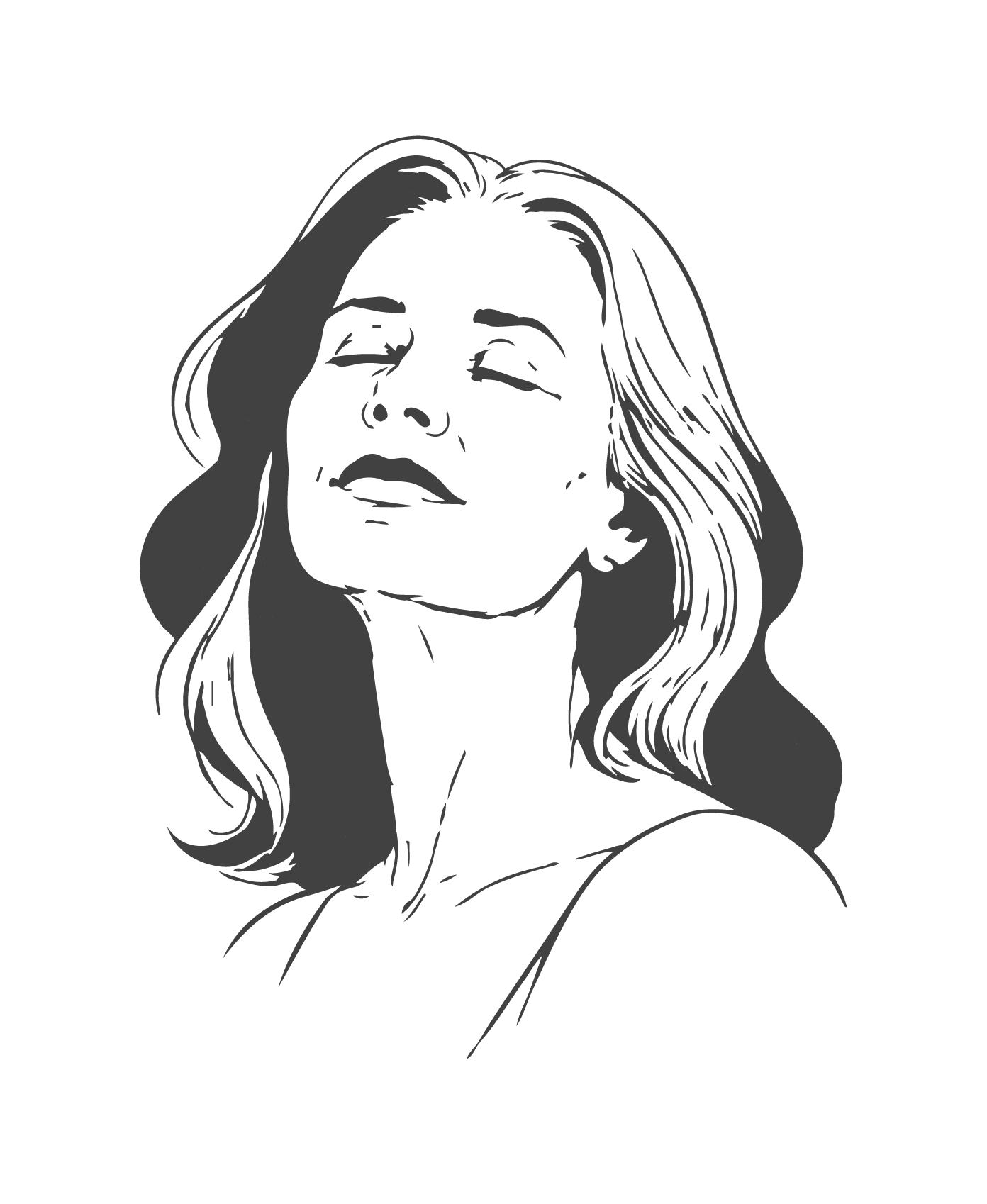
The dress in the back of the wardrobe
She finds it while looking for a scarf. A dress she wore at thirty-five, black and slightly reckless, with a neckline that made her feel as though she had stepped into the world two seconds before everyone else. She remembers the restaurant, an evening full of noisy strangers and the delicious sense that she could be seen and still remain entirely her own.
Now she holds it against herself and feels several things at once. Fondness for the younger woman. A small sadness about the ways her body has changed. Amusement at the memory of those shoes. A question she has not asked for years: What would I wear if nobody were expecting me to look appropriate for my age?
She does not necessarily want the old body back. She wants to know when she agreed that the present one had to become less visible.
A woman’s body has public assignments. Be attractive, but not threatening. Be fertile, but not inconveniently pregnant. Look maternal, but recover your figure. Age gracefully, but do not show too much evidence of ageing. Remain desirable, but stop behaving as though you have any personal claim to desire after a certain birthday.
The instructions are contradictory enough to be comedy. They have also been remarkably effective.
The public job was never the whole job
A body is not a performance invented for the gaze of strangers. It carries a person from morning to evening. It lets her taste peaches, recognise a friend’s voice, climb stairs, cry in the cinema, feel cold against her wrists, rest her head against someone she loves. It can also hurt, become ill, develop impairments, and refuse an activity it once managed easily.
The public function, however, often becomes louder than the private one. A woman may learn to evaluate her body from the outside before noticing what it is actually experiencing. She studies the angle of her face on a screen. She watches herself walking past a shop window. She adjusts a garment because she has imagined the judgement of an audience she cannot even identify.
Fredrickson and Roberts’ influential objectification theory offered one account of how women may internalise an observer’s perspective on their bodies. It remains a framework, not a universal explanation of every woman’s experience. Still, the distinction between inhabiting a body and monitoring it for an audience can illuminate ordinary moments with startling precision.
When the dress stops fitting, what exactly has been lost? A garment? A silhouette? A version of how she was seen? Or a quality of freedom she once associated with moving through the world?
Those losses are not the same. They may ask for different forms of attention.
The age when the rules become visible
Some women experience ageing as a painful reduction in social attention. Others experience it as relief. Many feel both, sometimes in the same afternoon. There are days when being overlooked feels like being erased and days when it feels like a well-earned holiday from surveillance.
Crone must have room for both. The fantasy of a woman who suddenly becomes indifferent to beauty is as narrow as the fantasy that beauty is the only form of value she ever possessed.
Some women love fashion throughout their lives. Some love make-up, perfume, jewellery, sensual clothing and looking extraordinary. There is no emancipation in telling them to become aesthetically austere. The question is whether these pleasures remain choices, or whether the body has become a project managed under the threat of social exile.
A woman can delight in a red dress at seventy. She can also enjoy a shapeless sweater and decide not to apologise for it. Neither is the correct feminist uniform.
The more useful freedom is the capacity to move between forms of expression without being forced to justify why this body, at this age, deserves the space it occupies.
Ageism complicates the picture. The World Health Organization’s global report on ageism documents the broader social consequences of age-based stereotypes, prejudice and discrimination. The evidence is about social conditions, not a claim that every older woman experiences the same rejection.
It would be disingenuous to tell a woman that all her concerns about visibility are inventions of her mind. Workplaces, cultural industries and intimate life can impose real costs on women as they age. Liberation cannot be achieved merely by instructing them to stop noticing the structure.
The body after reproduction
For women who menstruate and experience menopause, the body may move through changes in cycles, temperature, sleep, genitourinary health and other symptoms. The details vary, and significant symptoms deserve individual medical care. The NICE guidance on menopause distinguishes clinical questions that should not be collapsed into a spiritual story about transformation.
Yet beyond the clinical changes is a social question: What happens when a woman’s body is no longer being imagined primarily in relation to reproductive potential?
Not every woman has given birth. Not every woman has wanted to. Not every woman has a womb, menstruates, or experiences the same bodily transition. A life is not validated by reproduction. Still, many women have grown up in cultures that quietly treat the reproductive body as a public concern.
The expectation is extraordinary. From adolescence onward, her body can be discussed as though it carries a future obligation to someone else. When will she have children? Will she have another? Should she freeze her eggs? Has she returned to her previous shape? Why does she not look more youthful? How long will she remain sexually available?
Then, at some indistinct point, the public begins to behave as though the whole assignment has been completed. The woman is expected to retreat with grace and perhaps take up gardening.
Gardening is lovely. It is not the only possible sequel to an entire human life.
A private encounter with skin
At The Motherhole I would like to ask a question that does not require a photograph. What does your body feel like from the inside, right now, when nobody is evaluating how it looks?
Some women might answer easily: warm, heavy, curious, tired. Others may initially find the question strange. The habit of self-surveillance can make lived sensation harder to hear. Even so, we should not turn inward attention into a new standard a woman must achieve.
There are reasons people avoid sensation. Pain may be present. Trauma may make certain practices difficult. Illness, disability or a medical procedure may have altered how a body can be inhabited. A practice that invites awareness should permit distance, movement, uncertainty and the right to stop.
Perhaps the woman notices the weight of her legs against the chair. Perhaps she hears a sound from the street. Perhaps she remembers the taste of an orange she ate in childhood. Memory participates in bodily experience without producing a neat historical explanation.
In the Sensual Encyclopedia, a range of ideas about sensation and sensual life can be explored without treating erotic response as the compulsory outcome. It is useful to remember that pleasure can be quiet, sensory and unrelated to anyone else’s gaze.
A woman may experience a warm bath as pleasure. She may enjoy the astonishing competence of her hands while repairing something. She may find the smell of a library intoxicating. She may like the ordinary contact of bare feet on a wooden floor.
There are forms of sensuality nobody will ever rate on a dating app. Thank God.
The grief that doesn’t need correction
There may be real grief here. A woman may miss her earlier energy, the ease of movement, fertility, a particular kind of attention, or the body she had before illness. She may not be interested in a lecture on how beautiful every age is. The lecture can feel like another instruction about what she is allowed to experience.
If she says, I miss my old body, the answer need not be, But your current body is powerful. Perhaps it is. Perhaps it is also painful. Perhaps she knows both and still feels loss.
What would happen if we let the grief be specific? She misses dancing for hours without consequences. She misses a form of sexual sensation. She misses the ability to sleep through the night. She misses being recognised in photographs. The list may be mundane, tender, unexpectedly funny. Each item deserves its own reality.
To become intimate with an experience is not to declare it good. It is to stop treating its existence as evidence that the woman herself has failed.
This is especially important when pain or disease is involved. Nobody should have to recast illness as a gift in order to receive compassionate attention. We wrote about that refusal in Pain Does Not Need to Make You Profound.
A body can change without becoming a moral lesson.
A woman reassigns the job
Imagine that she tries on the black dress. It fits differently. She likes one aspect of it more now and another less. She might decide to have it altered. She might give it away. She might hang it back and wear something else entirely.
The choice is small. The meaning lies in who is making it.
She does not have to prove that she is still young. She does not have to prove that age has made her immune to vanity. She does not have to dress for somebody else’s comfort or rebellion against their expectations. She can simply make a decision about the clothes in front of her and the person she happens to be today.
That person has memory, desire, embarrassment, pride and a body doing its best under changing conditions. She may feel unseen in one room and grateful for anonymity in another. She can ask for medical care when something hurts and still enjoy a sensual life that refuses to be reduced to a diagnosis.
Her public job was never the whole of her.
It is perhaps time to stop reporting for duty whenever the world decides to inspect her.
The woman in the shop window
Later, she passes a shopfront and catches her reflection. The familiar impulse arrives, almost automatic: adjust the jacket, inspect the face, judge the shape. She notices it, not with fury, but with the curiosity one might give an old employee who has turned up on a day when nobody scheduled them.
You can go home, she thinks.
The woman in the glass does not become younger. Her body does not suddenly feel perfect. She is still carrying a shopping bag and wondering whether there is bread at home. Nothing in the external world has been fixed.
But for a moment she encounters her reflection as evidence of a life rather than an application for approval.
She keeps walking.
The body comes with her. It always did.
Connected reading
- The Shame of Being Seen to Age, on the public gaze and age.
- The Heat Is Real: Menopause Without Metaphor, on symptoms that deserve literal care.
- What Happens When Approval Stops Paying, on recognition and freedom.
- Swedish Institute of Inner Technology, for a wider view of human capacities and embodied experience.
This essay discusses body image, ageing and varied experiences of menopause. It does not treat medical problems as metaphors or assume all women’s bodies follow the same course.
A free course to continue
Meeting the Changing Body
Notice change without demanding a lesson from it. Make an observation, try a practical adjustment and identify when professional care belongs in the picture. Free at the Sensual Institute; account and login required.