
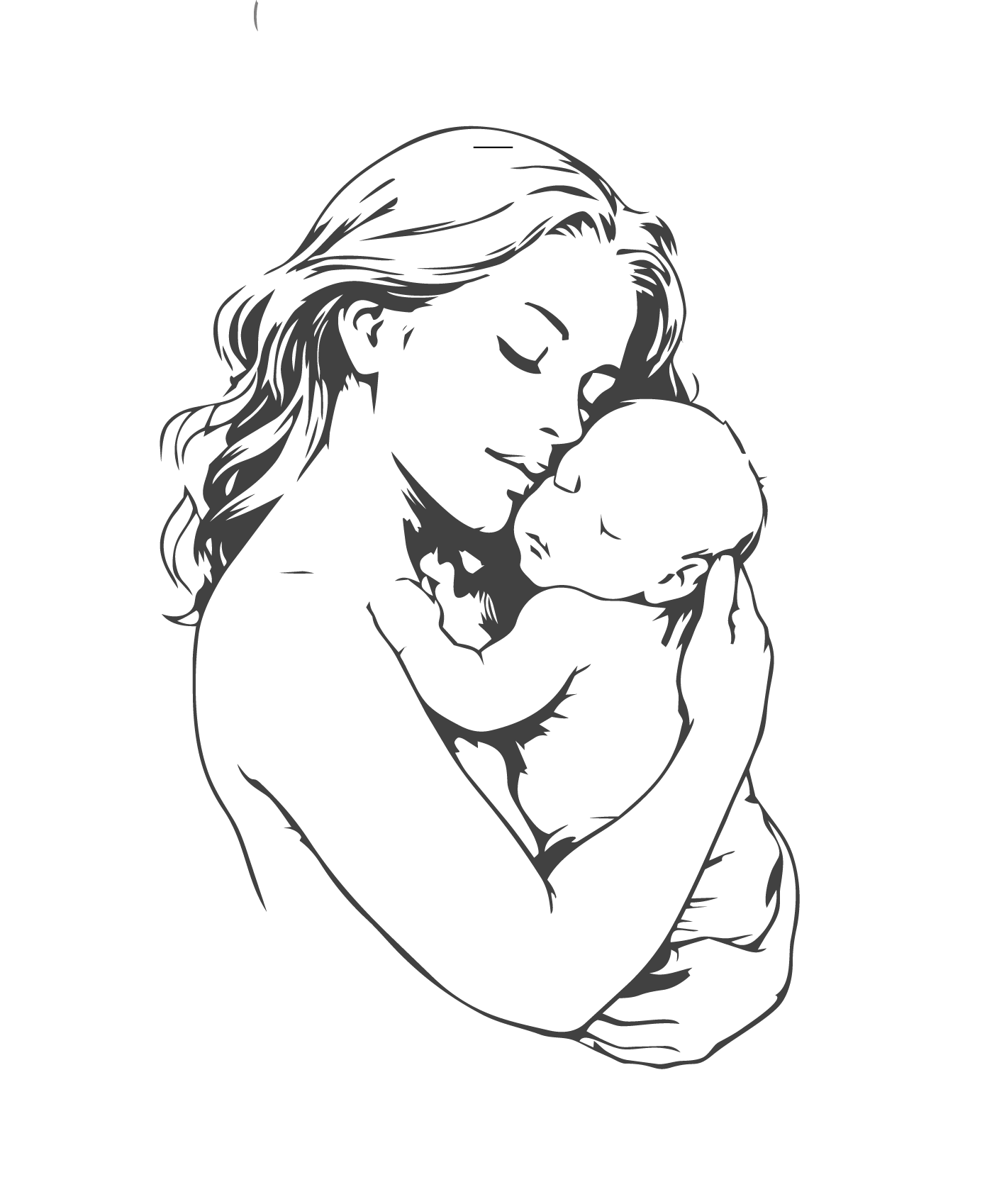
A sentence at the kitchen table
A woman has been awake three times in the night. The baby is finally asleep. The washing machine has stopped with a small, accusatory beep. She has a meeting in forty minutes and no clean shirt that fits comfortably.
She says, not elegantly, that she cannot keep doing everything.
Someone answers, "Well, you chose to have children."
The sentence falls between the cups on the table and changes the subject. The issue was how responsibilities are divided. The answer has made it a referendum on whether she is grateful for her life.
She does love her children. That is not in question. It is precisely because she loves them that she has been staying awake, showing up, rearranging work, remembering appointments and learning a thousand new things she never anticipated. Yet her expression of strain is suddenly treated as a complaint about the children themselves.
You chose this is powerful because it contains a truth. People make choices. Choices have consequences. It becomes dishonest when that truth is used to hide all the conditions that follow.
Choice is not a blank cheque
Choosing parenthood is not choosing every subsequent inequality. A person may knowingly decide to care for a child without agreeing to do almost all the night work, domestic administration and emotional management while somebody else retains an uninterrupted career.
Nor does a choice made at one moment erase the right to negotiate changed circumstances. No one knows in advance exactly what a birth will bring: a child’s needs, a parent’s recovery, job conditions, housing, health, relationship changes, or the availability of support.
A decision is made in a real world, with partial information. Responsibility grows from the decision; unlimited personal liability does not automatically follow.
Imagine applying the same logic elsewhere. A person who chose a profession would not thereby consent to unsafe working conditions. Someone who chose to marry would not lose the right to object to mistreatment. Somebody who bought a house would still be allowed to complain that the roof leaked.
Yet a mother’s choice is often used to render the infrastructure around her invisible.
The accusation behind the argument
The difficulty with the sentence lies in what it does emotionally. It requires a woman to prove that she loves the life she is asking to change.
The argument becomes circular. If she says she is exhausted, she is ungrateful. If she says she needs help, she is failing to cope with her choice. If she says she misses solitude or work or her former body, she must be sorry she became a mother.
Love and difficulty are positioned as opposites. They are not.
A person can love a child and find care exhausting. She can experience extraordinary joy and still resent unfair arrangements. She can choose parenthood and mourn other possible lives. Those experiences are not evidence that the original decision was wrong.
In Joy Is Not a Betrayal of What Hurts, we meet the opposite assumption: that pain should invalidate pleasure. Both mistakes insist that a human life must be emotionally consistent to be legitimate.
It doesn’t.
Who was actually allowed to choose?
The language of choice can also flatten very different conditions. Not all pregnancies are planned or wanted. Access to contraception, abortion, healthcare, housing, education and safe relationships varies. Some people become parents through coercion, pressure, complicated circumstances or situations in which the alternatives were not genuinely available.
We should not use the language of choice as though everybody arrived at parenthood from an equal position. Nor should we assume that every parent is a woman or that all women become parents.
Even within a freely chosen pregnancy, the distribution of care is shaped by paid leave, income, employers, family expectations and the other adults who are present. The moral tone of you chose this conveniently avoids questions about who controls those arrangements.
A mother who wants another person to share a responsibility is not necessarily trying to escape the consequences of her decision. She may be asking the other person to acknowledge consequences that belong to them too.
The invisible contract
Many households contain an agreement nobody remembers signing. One person notices what is missing; the other responds when asked. One person plans; the other helps. One person keeps the timeline of the family in her head; the other experiences individual tasks as favours.
The difference matters. Helping is often voluntary, bounded and visible. Responsibility includes noticing, remembering, deciding and following through. When one partner is the manager of everybody else’s help, the management itself becomes labour.
There is no single fair arrangement for every family. Paid work, disability, childcare, personal capacities and preferences differ. A one-size-fits-all distribution would ignore real circumstances. But fairness is not measured solely by who performed the most chores last Tuesday. It includes who is continually on call, whose career bends, whose body absorbs sleep loss and who has the practical authority to stop.
The United Nations Sustainable Development Goal on unpaid care and domestic work recognises that these activities and their distribution are matters of public concern, not merely private temperament.
The sentence you chose this makes a public and relational question look like one woman’s attitude problem.
Children need people, not martyrs
There is another reason to challenge the argument. Children do not benefit from a social model in which care is treated as the unpaid obligation of one uncomplaining adult.
They need reliable care, safety and responsiveness. Those can be provided by different constellations of adults, depending on the family. They do not require a mother to erase the boundaries between devotion and self-destruction.
A parent may sometimes need to place the child’s immediate needs first. That is part of caring for someone who cannot yet provide for themselves. But it does not mean that the entire life of the parent must disappear into the child’s demands.
Nor does it mean that a parent who loses her patience has made a wise point. Repair and accountability still matter. We can take children’s experiences seriously while taking caregivers’ conditions seriously too.
The point is not to release adults from responsibility. It is to distribute responsibility honestly.
The moral trap of gratitude
Gratitude is beautiful when it is freely felt. A mother might watch her child sleeping and experience the almost unbelievable fact that this particular person exists. She may feel lucky, humbled, astonished.
Then she may stand up and discover that the floor is covered in cereal.
One experience does not cancel the other.
The demand to be grateful can become a way of silencing legitimate complaints. Women are sometimes told to cherish every moment because children grow quickly, because others wish they could become parents, because this is supposedly the best time of their lives.
Such statements can be true for someone and still be unhelpful when imposed on another. A grieving or infertile person’s loss is not a tool for disciplining a tired mother. The passage of childhood does not remove the immediate need for sleep.
What if we let gratitude remain an emotion rather than turning it into a condition of access to support?
The conversation worth having
Return to the kitchen. The baby is asleep. The washing machine has finished. The woman says she cannot continue as things are.
Instead of a verdict about her choices, the other person might ask what specifically cannot continue. The three night wakings? The fact that she schedules every appointment? The absence of time alone? The way her employer responds to caregiving? The imbalance between two people who both work?
The answers may be uncomfortable. They may involve money. They may involve an honest recognition that both people are already stretched. They may involve a need for external support that neither partner can provide alone.
A conversation about logistics is not always romantic. Sometimes it is what makes romance possible again.
There may also be no other person at the table. Single parents need more than advice to negotiate with a partner who does not exist. They need policies and practical networks that recognise care as work essential to society.
A woman’s decision to love a child did not create the entire social world in which that love must operate.
More than a defence
We do not have to make motherhood sound miserable in order to recognise injustice. It can be funny, luminous, ferocious, boring, astonishing, dull, erotic, tender and transformative. It can hold the best hour of a life and the worst night of a year.
The argument against you chose this is not that the mother made no choice. It is that choice did not remove her humanity, and parenthood did not remove anybody else’s responsibility.
She is allowed to love what she chose and still ask for different conditions in which to live it.
Her children are not on trial. Neither is her gratitude.
The washing machine beeps again. Someone else can get up.
Connected conversations
- The Hours Nobody Counts, on invisible care work.
- The Family Group Chat as Invisible Labor, on the new interfaces of responsibility.
- The Cost No One Put on the Birth Plan, on the gap between expectation and lived conditions.
- United Nations, SDG 5, including recognition of unpaid care.
- The Sensual Institute, on embodied experience and its social context.
This essay examines ethical and structural questions. It is not a verdict on any individual family, and the safest way to address an unequal relationship depends on the actual circumstances.
A free course to continue
Love and Resentment Can Share a Body
Make room for devotion and strain in the same experience. Name an unmet need and turn it into a concrete request. Free at the Sensual Institute; account and login required.