
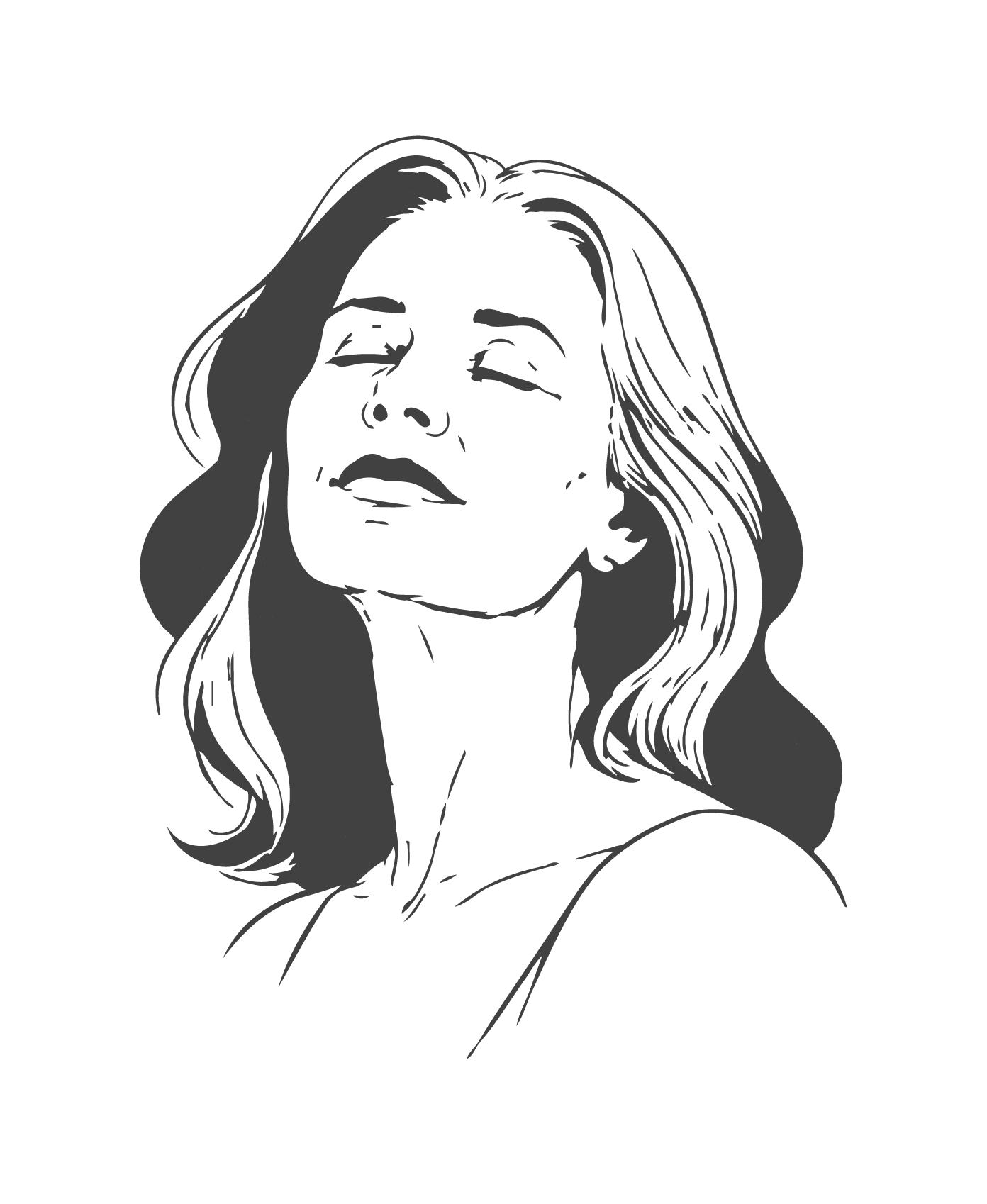
The chair she almost moves
A woman arrives at a gathering ten minutes early. The room is filling. She chooses a chair in the middle, puts down her coat and opens her notebook.
Then she notices that somebody will need to walk around her to reach the window. She considers moving to the edge. Perhaps the middle is for people who have something important to say. Perhaps she is in the way.
It is an almost invisible calculation. No one has asked her to move. Nobody has even looked annoyed. She is negotiating with a room that has not objected to her presence.
For many women this negotiation begins long before middle age. Make yourself smaller on public transport. Do not speak too long. Soften the criticism. Step aside to let somebody more confident go first. It may be taught as politeness, and politeness can be generous. The difficulty comes when generosity becomes an automatic surrender of one’s own position.
Later, when a woman is older, the instructions may become contradictory. She is told to be powerful but not abrasive, attractive but not vain, experienced but not resistant to change. She must age gracefully, a phrase that often means making the process aesthetically reassuring to the people watching.
There is a peculiar freedom in discovering that the room was never asking for an apology.
Space is not only a metaphor
A woman occupies physical space with her body, political space with her voice and social space with her needs. She occupies time when she asks a question that requires more than a quick answer. She occupies attention when she tells a story that is not designed to flatter the audience.
All of these can be contested.
Think of seating in a professional meeting, the design of public toilets, medical appointments where symptoms are hurried through, clothing shops that stop displaying certain bodies, cultural conversations in which older women are invited to be inspirational but rarely allowed to be uncertain or angry.
Ageism is not merely a private fear of wrinkles. It can operate through hiring, healthcare, design and the assumptions people make about what a life past a certain age ought to contain. The World Health Organization’s work on ageism treats it as a social issue with consequences for health and participation, not just an unpleasant opinion.
The right to take up space therefore has both an intimate and a public meaning. You may need to feel entitled to remain in the chair. The room must also be organised so you can enter it.
Neither half can replace the other.
The body becomes public property
The older female body is subjected to strange commentary. People offer reassurance that she looks young, as though youth were the only acceptable form of visibility. They compliment her for not "letting herself go," implying a moral failure in any body that changes beyond the approved limits. They praise confidence while selling an endless programme of correction.
A woman can enjoy makeup, fashion, cosmetic procedures and beauty without betraying herself. She can also want none of them. The point is not to demand that every woman make a political statement with her face.
The point is the right to choose without having every choice translated into evidence of her worth.
A woman may feel grief when her appearance changes. She may miss a former version of her body, or feel relief at no longer trying to attract a particular gaze. She may become more sensual. She may feel entirely indifferent. Those positions can change over time.
In The Shame of Being Seen to Age, we explore what happens when visibility itself feels like exposure. Here the question is more concrete: can she continue to inhabit the world without being required to justify the body she brings into it?
She is not an unfinished advertising campaign.
The pause before a sentence
Many women learn a conversational style full of small concessions: This might be stupid. I could be wrong. Sorry, just one thing. I don’t want to take too much time.
Some hesitations are appropriate. Intellectual humility is valuable. We should remain open to correction. But the reflexive apology can become a tax on ordinary participation.
Notice the different effort required to say "I disagree" and "Sorry, I might be completely misunderstanding, but I wondered whether there might be another way of thinking about this." The second may be tactful in one room and self-erasing in another.
The mature skill is discernment, not relentless bluntness.
There are circumstances where speaking directly is unsafe, where diplomacy protects livelihood, relationships or physical security. A woman’s ability to take up space is not solely a question of personal confidence. Power is real.
But where she has room to choose, she can experiment with allowing a sentence to stand without padding it to make everybody comfortable.
She can even be wrong. Taking up space includes the right to contribute imperfectly.
What fear knows about the centre
For a woman accustomed to caring for others, visibility may feel like a betrayal of the role she has occupied. Being the organiser is familiar; becoming the person whose experience matters is not.
She may sit in a circle and hear another woman describe anger, loneliness or pleasure. The response rises in her chest. She knows exactly what she would say if speaking were not going to make her visible.
Then the old calculation begins. Does this sound ridiculous? Will somebody judge me? What if I cry? What if I cannot explain?
There is no obligation to speak. Silence can be a sovereign choice, not only a sign of fear. A circle should not turn disclosure into a performance of courage.
Yet it matters that the option exists, that listening women are not waiting to diagnose her, that another person’s story may be allowed to meet hers without a competition over suffering.
We are practising a modest political act: making a room in which an older woman’s presence is not an interruption.
Ambition doesn’t expire
There is a persistent cultural arrangement in which younger people are allowed to have plans and older people are asked to share lessons. The woman past midlife is invited to mentor, volunteer, care, advise and pass on what she knows. Those can be marvellous things to do.
But what if she also wants to begin?
A new business. A degree. A relationship. A different style of dancing. A book that has nothing to do with her family history. A journey that nobody else understands. A season of doing almost nothing.
Ambition need not be productive to deserve a place. A woman is allowed to want a life that is not justified by its usefulness to the next generation.
An ageing body may impose real changes and limits. Money, illness, disability and care responsibilities may narrow the available choices. The answer is not to promise that anything is possible with the right attitude. That would simply replace one impossible demand with another.
The answer is to ask what is actually possible, what support would change it, and why desire should become socially embarrassing at a certain age.
Crone is not a costume
The Crone has become a seductive contemporary image: silver hair, unshakeable boundaries, perfect intuition, a woman who no longer gives a damn.
She sounds delightful. She is also an impossible standard.
An actual woman may be frightened. She may be unsure whether she has become less tolerant because she is clearer or because she is exhausted. She may be tender towards people whose approval she still longs for. She may want to be noticed and resent being watched.
Ownership is not the absence of contradictory feeling. It is the ability to relate to what is happening without immediately surrendering the right to decide.
In The Crone Who Cannot Feel Wise, wisdom is not compulsory. The same is true of fearlessness.
A woman can take up space while trembling.
The politics of the ordinary chair
The question returns to that chair in the middle of the room. She can stay. She can also move if she wants to. The difference lies in the freedom of the choice.
Some days she will be expansive. Other days she will want to disappear under a blanket. Neither condition makes her an illegitimate participant in life.
We might begin by refusing one unnecessary reduction. The woman is not merely somebody’s mother, an experienced colleague, a patient, an ageing body or a source of wisdom for younger people. She is all of those at times, perhaps, and still more than their sum.
She can be inconvenient. She can be helpful. She can ask for another five minutes. She can recognise when another person needs the floor. She can change her mind about the whole evening.
The gathering begins. A woman on the far side of the circle speaks about something she has never told anybody. The woman in the middle listens, feeling the weight of her body in the chair.
She is not blocking the way to the window.
She is here.
Related essays and sources
- The Woman Who Stops Explaining, on the cost of perpetual justification.
- An Authority You Did Not Apply For, on visibility and power in midlife.
- World Health Organization: Ageism, on age-related discrimination and health.
- The Sensual Institute, for embodied learning and human connection.
- Institute of Inner Technology, Human Capacities, for questions of agency and social conditions.
This essay concerns lived experience and social conditions. It does not suggest that individual confidence alone can overcome discrimination, disability or unsafe power dynamics.