
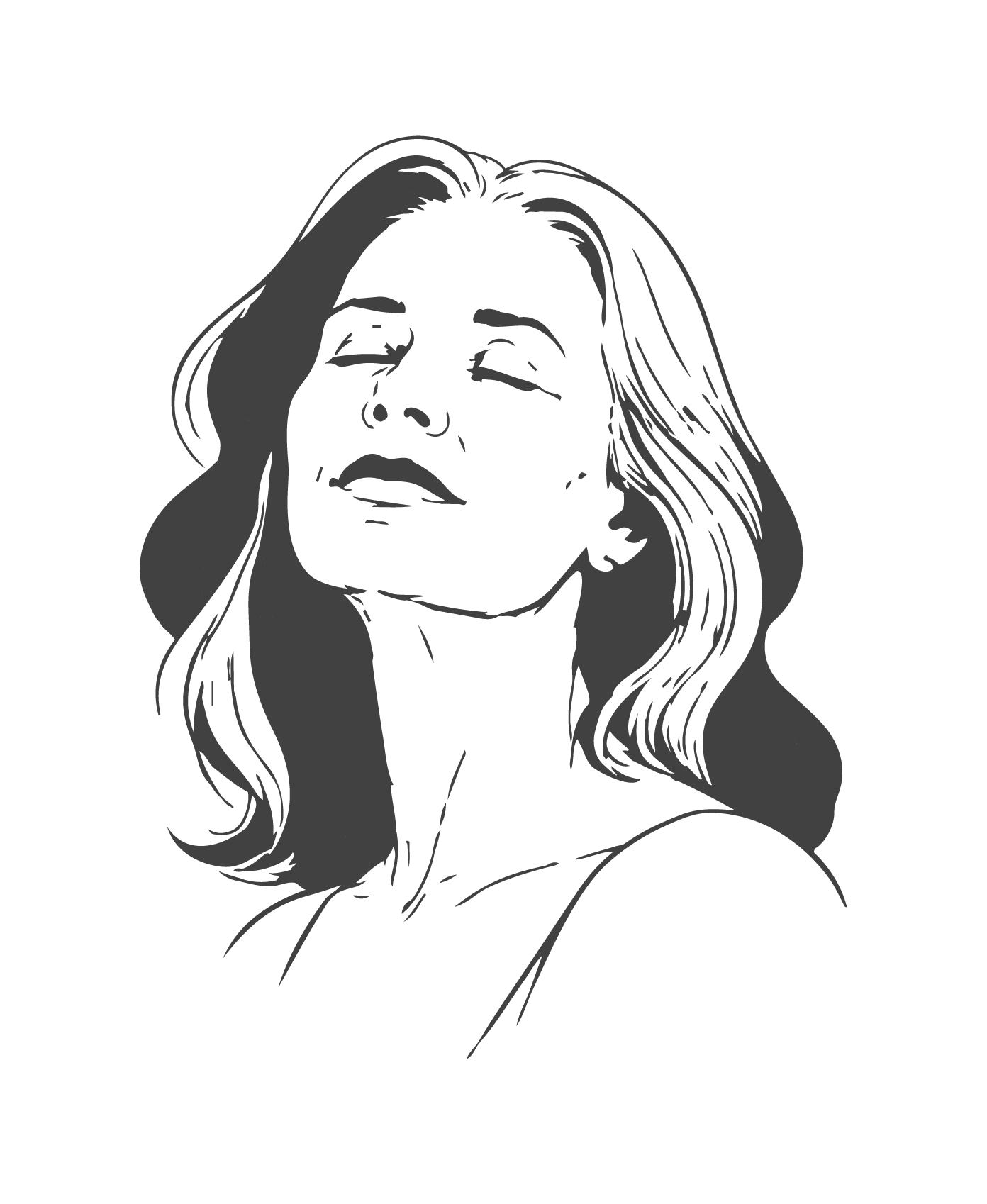
She is standing in the middle of a supermarket, holding two nearly identical jars of olives, and she cannot remember which one she came for.
This would be an unremarkable event under ordinary circumstances. People forget things. Supermarkets are engineered to make a simple errand feel like a cognitive obstacle course. But she has been losing words lately, misplacing appointments, waking at three in the morning with her heart thudding, and looking at her own life as though someone has adjusted the lighting while she was out of the room.
The olives become evidence.
Evidence that something is wrong. Evidence that she is becoming old. Evidence that she has lost the sharpness other people relied upon, the sharpness she herself relied upon, the private understanding that she was at least capable of finding her way through the day.
She puts one jar back. Then she picks it up again.
And somewhere beneath the confusion there is anger. Not a dignified, ancestral anger. A plain, sour, furious little voice asking why, after all these years of managing everyone else’s crises, she must now learn to manage her own body as though it were a badly maintained appliance.
This is not the version of the Crone that appears on the inspirational poster.
Good. We should talk about her too.
The trouble with the wise woman
There is a beautiful archetype available to women approaching and moving through menopause. The Crone who knows herself. She no longer needs permission. She has laid down the performances of youth and found a severe, luminous authority. She says no without apologizing. She walks into a room and everybody can feel that she belongs to herself.
Sometimes a woman does experience that release. Sometimes she experiences it on Tuesday and loses it by Thursday. Sometimes the transition arrives not as a coronation but as confusion, grief, fear, insomnia, physical pain, a sudden loss of interest in sex, or a morning when she cannot bear to look at the photographs of the person she used to be.
And sometimes she feels well, attractive, curious and entirely uninterested in anyone’s story about what this period is supposed to mean.
A useful archetype should be able to hold all of these possibilities. If Crone requires serenity, certainty and magnificent boundaries before a woman can claim the territory, it has become another performance standard. Another demand to convert an untidy life into a flattering image.
We have enough of those.
Crone is not the identity of a perfectly wise older woman. It is a territory in which authority, limits, bodily change, experience and social meaning become difficult to avoid. It can be entered through delight or disorientation. It can include menopause without being restricted to a menstrual milestone. It can be lived by women who feel powerful and by women who, for the moment, do not feel much of anything.
The experience is real. It is not a verdict on the person having it.
The body has its own news
There is a risk in philosophical writing about menopause. We can make the changes sound so meaningful that we forget they are also physical.
Hormonal fluctuations and the menopausal transition may be associated with hot flushes, disrupted sleep, genitourinary symptoms, joint and muscle pain, sexual difficulties, low mood and other symptoms. These vary considerably. Some people experience little disruption; others find that ordinary life becomes difficult. The UK National Institute for Health and Care Excellence recommends individualised assessment and offers evidence-based management options depending on symptoms, preferences and clinical circumstances.
This is not a matter of choosing a beautiful interpretation over treatment. Persistent pain, disruptive symptoms, unusual bleeding or significant mood changes deserve appropriate medical attention. Depression is not a spiritual initiation. Severe insomnia is not a sign that the soul is becoming more alert. And nobody should be required to earn healthcare by proving that she has approached her suffering with sufficient grace.
At the same time, a woman’s experience cannot be reduced to hormone concentrations and laboratory results alone. Her relationships, employment, sleep, financial position, disability, culture, previous experiences and current responsibilities also shape what she is living through. A specialist may help with the medical dimension. A trusted friend may help her be less alone. A change in workload may be necessary. Several kinds of care can be true at once.
There is no prize for selecting only one explanation.
The humiliation of not knowing
Confusion is particularly hard on women who have survived by being competent.
For decades she may have been the translator of everyone else’s needs. She could hear a change in tone and know that someone was upset. She could identify the missing item before the meeting began. She could calculate school schedules, cash flow, train delays, the mood of the person arriving home, and the exact minute at which it would be sensible to stop speaking.
Knowledge became safety. Anticipation became character. Being on top of things was how she made herself necessary, and how she kept the world manageable.
Now a word disappears in the middle of a sentence. She gets halfway through an email and loses the point. She is not always sure whether she wants company or cannot endure being alone. If she has taken pride in being the person who knows, the uncertainty is not merely inconvenient. It threatens the architecture of her familiar self.
There are many possible causes of cognitive difficulties, from lack of sleep and stress to medication effects or conditions that require investigation. We must not decide from a distance that every moment of forgetfulness is menopause. Nor should we turn a common lapse into evidence of permanent decline.
But even after practical explanations are explored, the emotional blow may remain.
It can feel like being made incompetent in one’s own story.
A generous answer would be to reassure her that she is still wise. I am not convinced that is generous enough. Perhaps she is not wise about this. Perhaps she is frightened and disoriented, and cannot yet see a larger pattern. Why should she have to claim insight before she is allowed to be met?
She can be uncertain without becoming uncertainty.
That difference is not small.
The woman who is angry for reasons that are not all hormonal
Anger is an easy emotion to dismiss at midlife. A woman raises her voice and the room starts asking what her hormones are doing. Maybe hormonal change is relevant. Maybe she has had poor sleep for six months. Maybe her pain is real and unmanaged.
Maybe someone has spent twenty years interrupting her.
The presence of a physical explanation does not automatically cancel a social one. And the presence of a social grievance does not make the physical symptoms imaginary.
A woman may suddenly see how often she has made herself agreeable. She may be angry about unpaid labour, abandoned ambitions, unequal money, the number of apologies she has delivered in place of decisions. She may be angry at a partner she still loves. She may feel hatred towards a role she once chose, or resentment towards the people who depend upon her, without wanting harm to come to anyone.
Anger can carry information about violated limits, exhaustion or injustice. It can also distort perception, intensify conflict or invite actions she later regrets. It is an experience to meet with curiosity and discernment, not a throne from which to rule every encounter.
We do not need to make anger virtuous to let it speak.
And we do not need to make it shameful to establish boundaries around what people may do with it.
A woman can say, "I am furious," and then choose not to unload the whole fury onto the person who happens to be nearest. She can say, "This arrangement is unfair," without requiring a dramatic rupture that evening. She can identify what needs to change and what she is not yet ready to change.
That is ownership, even when she is trembling.
What if nothing moves?
Then there is numbness.
Not glamorous detachment. Not serenity. The flat season in which music she once loved sounds like ordinary noise, and the things that usually make her laugh fail to arrive with their expected colour.
People may tell her to rest, rediscover pleasure, take up painting, fall in love with herself, dance in the kitchen. Perhaps one of those suggestions will help. Perhaps the woman is already doing everything she can to make it to the end of the day.
Emotional numbness can arise in many contexts, including depression, sustained stress, grief, medication effects and other health conditions. It merits attention, especially when persistent or distressing. The meaning of one woman’s flatness cannot be determined by a metaphor or an online article.
But there is something else to say without trying to solve it.
The absence of feeling is also something a person may notice. She might be able to say, "The colour has gone out of things," without announcing that the rest of her life will be colourless. She might sit with a friend in companionable silence, not performing interest. She might discover that there are forms of contact available even when pleasure is not.
This is not a recommendation to accept severe symptoms without care. It is a refusal to make recovery a condition of belonging.
We do not invite women into conversation only after they feel better.
Memory keeps more than one version of the self
There is an old photograph on her phone. She is thirty-one, wearing shoes she would not choose now, laughing with her head thrown back. She looks at the picture and feels something complicated. Jealousy of her younger self. Tenderness for how little she knew. Anger that she spent so many of those years convinced she was insufficient. Surprise that she was, in fact, so beautiful.
Another photograph finds her holding a baby. Another catches a lover’s hand at the edge of the frame. Another shows her in a workplace she once believed would define her life. The photographs do not agree about who she is. They are not supposed to.
Memory is not a cupboard containing a single unchanging identity. What we recall, and how we understand it, can shift with present circumstances. Old experiences may acquire new meanings. A decision once felt as failure can later appear to have been a form of self-protection. A relationship remembered as entirely happy may become more complicated when the woman can finally name what she could not bear to question at the time.
That does not make every fresh interpretation true. Memories are reconstructive, and strong feeling cannot independently verify a past event. It means that the relationship between earlier life and present meaning is alive.
Here our map expands. There is bodily state, relational field, memory and anticipation. There is also something less easily described: the images, dreams, sensations and unformulated thoughts through which a woman may approach what she has not yet found words for.
Calling this a four-dimensional map is a metaphor for lived complexity, not a claim that psychology has discovered a fourth spatial dimension. It is a way to resist the idea that the woman at this moment can be understood by her age, her symptom list, her relationship status or a single prevailing mood.
A life is larger than its current weather.
The strange subject of power
If Crone is about ownership, what exactly is being owned?
Not always a house. Not necessarily money, though the material freedom money brings should never be dismissed. Not the ability to control other people. Not a perfect narrative about how the past made her stronger.
Perhaps ownership begins with the recognition that experience belongs to the person living it, even before she knows how to interpret it.
She is afraid. The fear is hers to notice, not necessarily hers to obey. She is angry. The anger belongs in the conversation, not in charge of every decision. She feels nothing. The numbness is real and may need help; it is not the final name of the woman. She wants something embarrassing, something socially complicated, something that would surprise the people who have known her longest. She can become curious before deciding what to do.
This is not emotional invulnerability. Quite the opposite. Intimacy with experience may require allowing difficult sensations to be present without demanding that they resolve immediately into wisdom.
Sometimes a woman needs a doctor. Sometimes a solicitor, a union representative, a trusted friend, a partner who listens without interrupting, a day off, a divorce, or a new set of possibilities she has never been shown. We should be interested in the conditions that make real choices available, not only in the internal courage required to choose.
You cannot meditate your way into an equal salary. You cannot manifest a health service appointment that does not exist. And you do not become more sovereign by pretending that pain never matters.
Authority is more interesting when it can ask for help.
No compulsory transformation
There are stories in which the heroine enters darkness and emerges carrying a magnificent gift. Such stories can be beautiful. They can also become cruel when imposed on a woman who has been in pain for a very long time.
Perhaps the menopause transition changes her life. Perhaps it brings freedom, clearer boundaries, new sexual possibilities, a renewed appetite for work, or a dramatic reduction in the need to please. Perhaps it brings no revelation whatsoever. Perhaps the most consequential event that year is not menopause but caring for a parent, losing a friend, discovering a new passion, or finding a community where nobody expects her to be useful every minute.
She does not have to become a symbol.
The Crone is available to women who feel wise and those who feel foolish, the woman enjoying her body and the woman living with pain, the woman in love and the woman who wants everyone to leave her alone. We can explore these differences without claiming they are identical.
No one is required to find beauty in suffering to have a place here. No one must turn anger into leadership or grief into purpose. Sometimes grief is grief, and rest is rest, and the right response to an awful month is to make next month less awful.
There is no failure in that.
Back among the olives
In the supermarket she finally chooses a jar. It might even be the wrong one.
Nothing is resolved. Her sleep may still be disrupted. She may need a medical consultation. The conversation she has postponed at home is still waiting. She still cannot remember the word she lost this morning.
But perhaps she notices something new. The mind has been building a catastrophe from an ordinary lapse and a series of genuinely difficult experiences. There is information in that fear, and there may be a need for practical action. There is no requirement to convert the whole of it into a story about who she has become.
She can be confused today. She can be furious tomorrow. She can feel tenderness for a former self and be bored by that same story an hour later. She can laugh at the wrong moment. She can say she does not know.
And she can still own her life.
Not because she has finally arrived as the wise woman.
Because she is the woman who is here.
That will do.
Continue through Transmissions
These experiences do not live in separate rooms. Follow a related conversation:
Research and reading notes
Clinical symptoms and treatment require individual assessment. The essay does not claim that all cognitive symptoms, pain or mood changes in midlife are caused by menopause. Seek appropriate medical support for significant or persistent symptoms, and urgent assistance for severe mental-health risk.
- NICE guideline NG23, Menopause: Identification and Management (updated 2026)
- NHS, Symptoms of menopause and perimenopause
- Susan Sontag, Illness as Metaphor, bibliographic record
- Institute of Inner Technology, Journal
- I AWAKE, the Nine Destinations
A free course to continue
A Feeling Is Not a Verdict
Separate what you feel, the story attached to it, and the next choice available. Make room for a difficult state without turning it into your whole identity. Free at the Sensual Institute; account and login required.